Mayavi മായാവി
A friendly kuttichathan, or forest imp, bound by gratitude to two children. Kind, sleepy, invisible when he likes, and helpless without his wand.
See Mayavi ↗Art © Balarama / MM Publications · image via Onmanorama, 2022Balarama · since August 1984
The little magician of the forest, two children, a red wand, and the villains a whole state learned to love.
ഓം ഹ്രീം കുട്ടിച്ചാത്താ!Om hreem kuttichaatha! (tap me)
A Friday ritual
For children growing up in Kerala from the 1980s onward, the week had a fixed point: the day the new Balarama arrived. Brothers and sisters fought over who read it first. Copies were hidden inside textbooks and read under desks. Playground nicknames were borrowed from its pages. And the first story everyone turned to was almost always the same one: Mayavi.
Balarama itself began on 1 March 1972 as a monthly from the Malayala Manorama group in Kottayam. It went fortnightly in November 1984, a few months after Mayavi arrived, and weekly in April 1999. By 2019 it reached an estimated 2.8 million readers, making it one of the most widely read children’s magazines in India.
August 1984
Mayavi first appeared in the August 1984 issue. He was created by N. M. Mohan, Balarama’s editor-in-charge from 1983 to 2012, with the Mumbai-based artist Pradeep Sathe. Later the strip was drawn by M. Mohandas, who gradually took over after the magazine went fortnightly, and by Thyagarajan.
The timing was magical in its own right. 1984 was also the year of My Dear Kuttichathan, India’s first 3D film, about another friendly imp. Kerala’s children met two kuttichathans in a single year, and both became legends.
How the magic works
His magic flows through a red wand shaped like a little mace. One wave can set off a whole chain of unlikely events, each one tumbling in the wand-holder’s favour.
Besides the wand, Mayavi can make himself invisible, which is how he so often slips past the villains’ traps.
He comes only when Raju and Radha say the chant. The rest of the time he lives alone in the forest, and is fond of a nap under a tree.
Without the wand he is powerless, and must obey whoever holds it. So every villain’s plan begins the same way: steal the wand, then reach for the bottle.
Who’s who in the forest
Links open the original Balarama artwork as published by Onmanorama, the publisher’s own English news site. The panels shown here are reproduced with credit for review. All artwork belongs to Balarama / MM Publications.
A friendly kuttichathan, or forest imp, bound by gratitude to two children. Kind, sleepy, invisible when he likes, and helpless without his wand.
See Mayavi ↗Art © Balarama / MM Publications · image via Onmanorama, 2022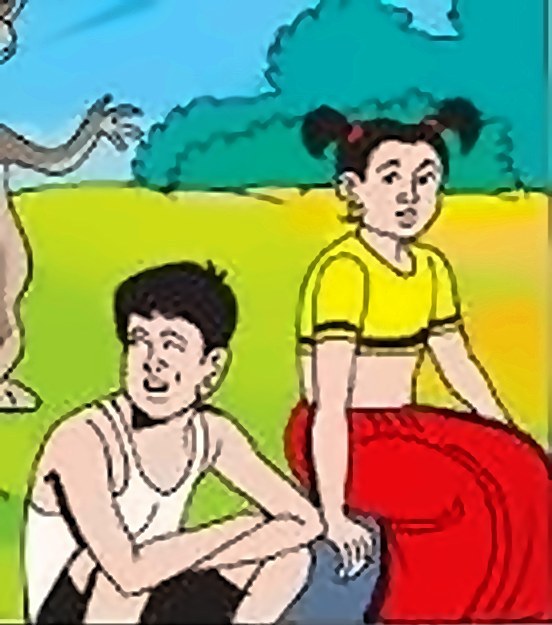
The children who freed him. They wander the forest, get into trouble, and are forever being kidnapped as bait to lure Mayavi out.
A bald, blue-robed dark wizard who lives in a hollow tree trunk. His one ambition is to capture Mayavi, and his clumsy spells keep backfiring on him.
See Kuttoosan ↗Art © Balarama / MM Publications · image via Onmanorama, 2022The witch with the noodle hair and a pet owl, Kuttoosan’s partner in crime. She nags him, mocks his magic, and is a coward when it counts.
See Dakini ↗Art © Balarama / MM Publications · image via Onmanorama, 2022A small red imp, Kuttoosan’s assistant and housekeeper, who flies on a magic spear steered with his tail. Cheeky, cowardly, and impossible not to love.
See Luttappi, old and new ↗Art © Balarama / MM Publications · image via Onmanorama, 2019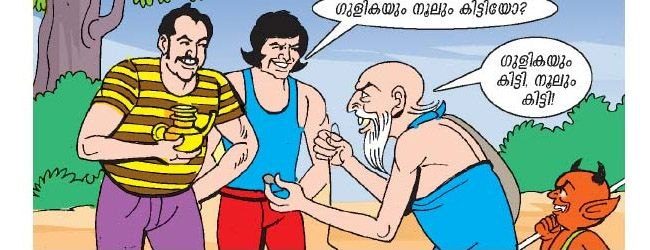
Two bandits hiding out in the forest, who help the villains for a price but hold no real grudge against Mayavi.
Two scientists whose inventions are forever being stolen by Vikraman and Muthu.
No official picture found onlineLuttappi’s big, dark-blue, sleepy uncle; Lamboochan, a calm senior wizard who supplies magic items; and Dingini, Dakini’s green-skinned niece, who arrived in 2019.
See Dingini ↗Art © Balarama / MM Publications · image via Onmanorama, 2019The villain who stole the show
Luttappi was first announced in an advertisement in June 1985 as Mayavi’s new rival, with his master Kuttoosan arriving soon after. He was meant to be a villain. Readers had other ideas. His cheek, his cowardice and his habit of laughing at himself won them over, and in time Luttappi overtook Mayavi himself as the strip’s most popular character.
In 2011 he and Mayavi were given new outfits after complaints from parents. In February 2019, when Dakini’s niece Dingini appeared and Luttappi went missing from an issue, fans flooded Balarama’s Facebook page with memes and hashtags like #Save_Luttappi and #Justice_for_Luttappi.
“Luttappi will never be removed. He will be back in the next issue.”A Balarama spokesperson, 2019
The shape of every story
The comfort was the point. Children knew the shape of the story, and the fun was in the surprises inside it: the new gadget, the new trick, the new way for Kuttoosan’s spell to blow up in his face.
Beyond the page
Mayavi debuts in Balarama, August issue.
Luttappi is introduced, then Kuttoosan.
A Malayalam film takes its title, Mayavi, from the strip.
A 3D animated Mayavi VCD, with a story by N. M. Mohan and a title song by Mohan Sithara.
N. M. Mohan dies on 12 December, aged 63.
Vikraman and Muthu turn up in the film Amen.
Dingini arrives; #Justice_for_Luttappi trends.
Balarama turns 50.
A Balarama-themed cave at the Wonderla amusement park is modelled on the characters, and in Aavesham (2024) a character’s style recalls Vikraman’s.
An appreciation
Mayavi is not a superhero. He does not save the world. He saves two children, in one forest, again and again. The stakes are small enough for a seven-year-old to hold in their hands, and that is the secret: the children are not rescued by chance. They call him. In every story, the power to summon help belongs to them.
His magic has rules, and the rules make the stories. A wand that can be stolen means a hero who can lose, and a hero who can lose is worth cheering for. The villains are never truly frightening. Kuttoosan is a failed wizard, Dakini a nag, Luttappi a coward with a flying spear. Kerala’s children learned early that evil is often ridiculous, and that laughing at it is half the battle.
Most of all, Mayavi belonged to a shared ritual: the weekly wait, the race to the newsagent, the copy passed from sibling to sibling and cousin to cousin. Many of the children who first said “ഓം ഹ്രീം കുട്ടിച്ചാത്താ” in 1984 now hand Balarama to their own children. The little magician is still answering the call.
In memory of N. M. Mohan (1949–2012), who gave Kerala its forest of magic.